Introduction
Did you know that in 2025, a significant 62% of teachers report frequent job-related stress, and 29% identify administrative work outside of teaching as a top source of that stress? The demands on educators are immense, with countless hours dedicated to crafting engaging and effective lesson plans, which is why many are beginning to explore the support of AI Lesson Planning Tools.
This often leaves teachers feeling overwhelmed, diverting valuable energy from direct student interaction, yet AI Lesson Planning Tools are emerging as a way to ease the burden. By reducing repetitive tasks, AI Lesson Planning Tools help educators focus on what matters most—student learning and engagement. In this context, AI Lesson Planning Tools are not just conveniences but practical solutions to modern teaching challenges.
But what if there was a way to reclaim those hours, reduce stress, and still deliver exceptional learning experiences? This guide explores the top AI Lesson Planning Tools for teachers in 2025, showing how these innovative platforms are revolutionizing classroom preparation.
By diving into AI Lesson Planning Tools, you’ll discover how to streamline your workflow, personalize learning, and bring new levels of creativity to your teaching. With AI Lesson Planning Tools, the process becomes more efficient, ultimately giving you back precious time and enhancing your professional life. In this way, AI Lesson Planning Tools serve as true partners in modern education.
What are AI Lesson Planning Tools?
At its core, an AI lesson planning tool is a software application that leverages artificial intelligence to assist educators in developing, customizing, and organizing their instructional materials. Think of it as a highly intelligent co-pilot for your curriculum development. These tools move beyond simple templates, utilizing advanced algorithms to understand learning objectives, student demographics, and content requirements to generate tailored lesson plans.
In 2025, the relevance of these tools is skyrocketing. As educational landscapes become more complex and diverse, teachers face increasing pressure to cater to individual learning styles, incorporate multimedia, and stay updated with evolving curriculum standards. AI offers a powerful solution by automating many time-consuming aspects of planning. Future trends indicate a move towards even more intuitive AI, capable of predicting student needs, adapting content in real-time, and integrating seamlessly with existing learning management systems.
According to research from Open2Study, by 2025, 65% of teachers are already using AI for academic work, with 21% reporting they use it for writing syllabi and 19% for generating quizzes and assessments. This data underscores a growing acceptance and integration of AI into daily teaching practices, moving it from a novel concept to an indispensable aid.
Why AI Lesson Planning Matters: Key Benefits for Educators
The adoption of AI lesson planning tools isn’t just about embracing new technology; it’s about fundamentally transforming the teaching experience for the better. These smart lesson design apps offer a multitude of benefits that directly address the challenges faced by today’s educators.
Streamline Curriculum Development
One of the most immediate advantages of AI lesson planning is its ability to accelerate and refine curriculum development. Instead of hours spent searching for resources, drafting objectives, and outlining activities, AI can generate initial frameworks in minutes.
- Rapid Content Generation: AI can quickly produce lesson objectives, summaries, discussion questions, and even entire activity ideas based on your input.
- Alignment with Standards: Many tools can cross-reference your plans with national or local curriculum standards, ensuring compliance and comprehensive coverage.
- Diverse Resource Suggestions: AI can scour the web for relevant videos, articles, interactive exercises, and simulations, presenting you with a curated list of high-quality resources.
Enhance Student Engagement & Personalization
Personalized learning is a pedagogical ideal that’s often difficult to achieve in a crowded classroom. AI lesson planning tools make this far more attainable by helping teachers tailor content to individual student needs and preferences.
- Differentiated Instruction: AI can suggest modifications for students with varying learning styles or abilities, generating adapted versions of assignments or offering alternative explanations.
- Interactive Activity Creation: From generating quizzes to proposing gamified learning experiences, AI helps you create dynamic content that captures students’ attention.
- Real-time Adaptation (with some advanced tools): Future iterations will increasingly allow for plans to adapt on the fly based on student performance data, ensuring every learner is challenged appropriately.
Save Time and Reduce Workload
The most cited benefit by educators is often the significant time savings. By automating the repetitive and administrative aspects of lesson creation, AI frees up teachers to focus on higher-level tasks.
- Automated Administrative Tasks: Imagine AI handling the initial drafting of rubrics, generating progress report templates, or even structuring parent communication.
- Efficient Resource Curation: No more sifting through endless search results; AI presents relevant resources, saving hours of research time.
- Focus on Pedagogy: With the groundwork laid, teachers can dedicate more time to refining instructional strategies, providing individualized feedback, and building stronger relationships with students. For more strategies to manage your teaching responsibilities, consider exploring practical approaches to effective classroom management.
Foster Creativity and Innovation
Far from stifling creativity, AI lesson planning tools can act as a springboard for innovative teaching. By handling the mundane, AI allows teachers to explore new pedagogical approaches and design truly unique learning experiences.
- Idea Generation: Stuck in a rut? AI can provide fresh perspectives and unconventional ideas for approaching a topic, sparking your own creative solutions.
- Exploration of New Formats: Experiment with project-based learning, inquiry-based lessons, or flipped classroom models with AI providing structural support.
- Seamless Integration of Technology: AI can help you weave in virtual reality, augmented reality, or interactive simulations, making your lessons cutting-edge and captivating.
How AI Lesson Planning Tools Work: Core Features & Functionality
The magic of AI lesson planning tools lies in their sophisticated algorithms and user-friendly interfaces, which work in concert to simplify and enhance the planning process. While specific features vary between platforms, the core functionality generally follows a clear, logical flow.
Here’s a step-by-step look at how these smart lesson design apps operate:
- Inputting Your Vision: You start by providing the AI with key information. This typically includes:
- Subject and Grade Level: e.g., “7th Grade Science”
- Learning Objectives/Standards: e.g., “Students will be able to identify the phases of the moon.”
- Duration of Lesson: e.g., “45 minutes” or “1 week unit”
- Student Demographics (optional but helpful): e.g., “Diverse learners, including 3 ESL students and 2 students with mild learning disabilities.”
- Specific Topics or Themes: e.g., “Photosynthesis,” “The American Revolution,” or “Algebraic Expressions.”
- AI Processing and Generation: Once you’ve provided the input, the AI engine gets to work. It uses Natural Language Processing (NLP) to understand your requests, taps into vast databases of educational content and pedagogical strategies, and employs machine learning algorithms to:
- Generate Lesson Frameworks: It can create a full lesson outline, complete with introduction, main activities, assessment ideas, and conclusions.
- Suggest Content & Resources: Based on the topic, it recommends relevant articles, videos, worksheets, and interactive tools.
- Differentiate Instruction: The AI can propose variations for different student groups, offering simplified explanations, extended challenges, or alternative assignments.
- Create Assessment Items: It can draft quizzes, exit tickets, and rubric components aligned with your objectives.
- Refinement and Customization: The AI-generated plan isn’t a final, rigid document. It serves as a strong starting point that you can then refine and customize.
- Edit and Adjust: You have full control to edit text, add your own activities, or remove suggestions that don’t fit your teaching style.
- Add Personal Touch: Integrate your unique insights, local examples, or specific classroom anecdotes.
- Iterate: Many tools allow for multiple iterations, letting you tweak prompts and generate different versions until you find the perfect fit.
- Export and Integration: Once satisfied, you can typically export your lesson plan in various formats (e.g., PDF, Word document, Google Docs) or integrate it directly with your existing learning management system (LMS) like Google Classroom or Canvas.
Conceptual Process Flow: From Idea to Implemented Lesson Plan with AI
| Step | Description | AI’s Role | Teacher’s Role |
|---|---|---|---|
| 1. Define Core Idea | Teacher identifies subject, topic, and general objectives. | Processes initial input (keywords, grade level). | Provides clear, concise initial parameters. |
| 2. Generate Draft | AI quickly creates a full lesson outline. | Generates objectives, activities, assessments, resources based on its knowledge base. | Reviews the draft for relevance and accuracy. |
| 3. Refine & Customize | Teacher modifies the draft to fit specific classroom needs. | Offers alternative suggestions, differentiates content for diverse learners, checks for alignment. | Edits content, adds personal anecdotes, integrates unique teaching methods. |
| 4. Resource Integration | Teacher incorporates external resources. | Suggests relevant videos, articles, interactive tools, and external links from reputable sources. | Selects, reviews, and adds preferred resources. |
| 5. Finalization | Teacher reviews the complete lesson plan. | Ensures all components are present, checks for consistency. | Gives final approval, ensures pedagogical soundness. |
| 6. Implementation | Teacher delivers the lesson to students. | (Future) Collects feedback, adapts in real-time, analyzes student performance to inform future plans. | Teaches, interacts with students, gathers qualitative feedback. |
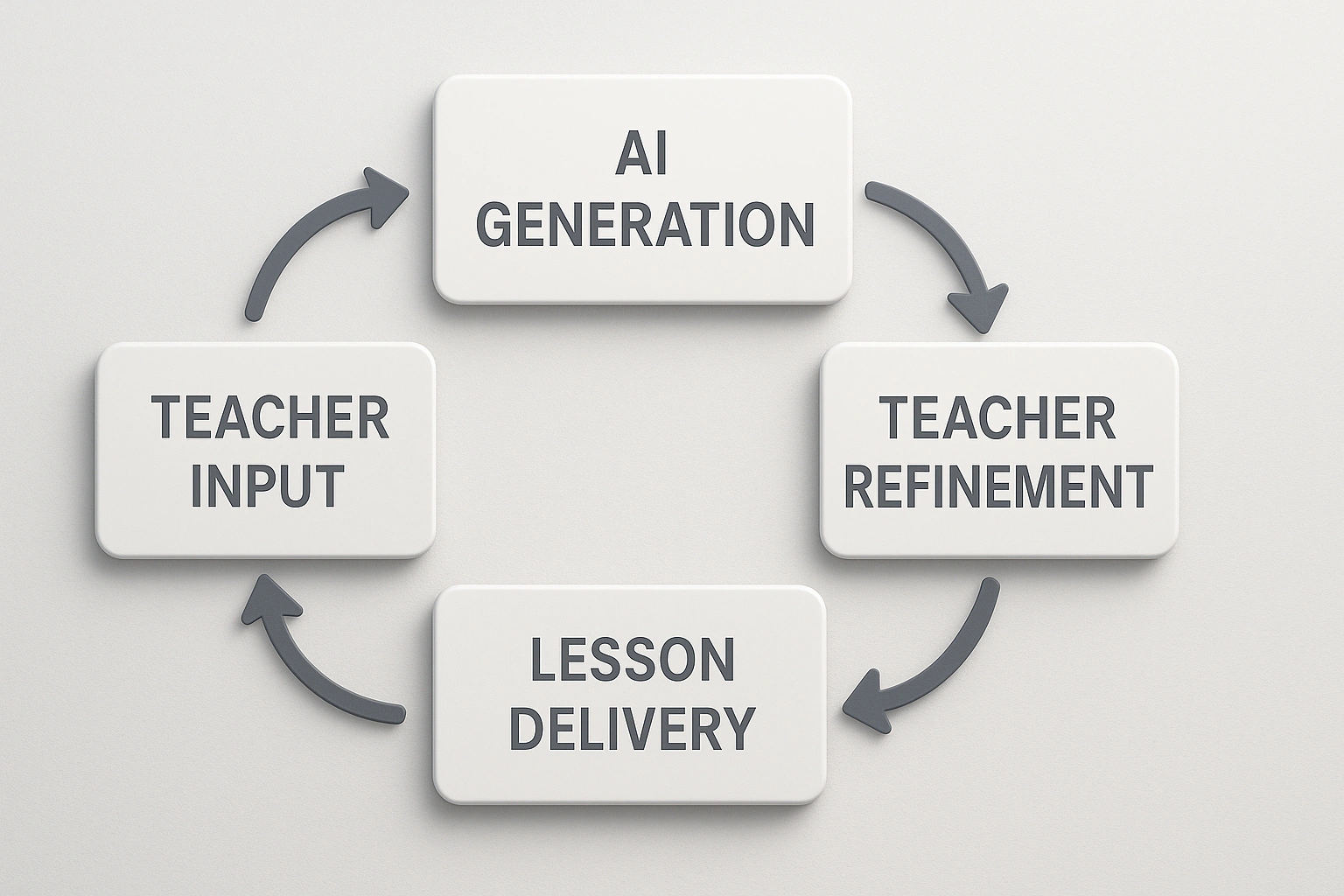
This systematic approach empowers teachers to leverage AI’s speed and vast information processing capabilities while maintaining their essential human touch and pedagogical expertise.
Real-Life Use Cases: AI in Action in the Classroom
Imagine a busy Tuesday evening. Ms. Chen, a 9th-grade history teacher, needs to prepare a unit on the American Civil Rights Movement for her diverse class. Historically, this would mean hours of research, outlining, finding relevant primary sources, and creating differentiated materials for her students with varying reading levels.
This year, Ms. Chen is using an AI lesson planning tool. She inputs her core objectives: students should understand key figures, major events, and the lasting impact of the movement. She specifies her class has a few English as a Second Language (ESL) learners and some who thrive with visual aids.
The AI tool instantly generates a comprehensive 5-day unit plan. It includes:
- Daily Learning Objectives: Clearly stated and aligned with state standards.
- Activity Suggestions: From a debate prompt on non-violent protest to a group project creating a digital timeline.
- Resource Links: Curated links to historical archives, documentary clips, and relevant news articles (including an external link to a reputable historical society).
- Differentiated Texts: The AI even provides slightly simplified versions of complex historical documents for her ESL students and suggests interactive maps for visual learners.
- Assessment Ideas: A short quiz, a rubric for the debate, and an outline for an essay prompt.
Ms. Chen reviews the plan. She praises its efficiency: “I saved at least 6-8 hours of initial planning time! The resources it pulled were spot-on, and I especially appreciated the differentiated materials—that alone is a huge time-saver.” She then takes the AI’s foundation and adds her unique spin: a guest speaker (a local civil rights activist she knows), and a class trip to a nearby museum.
Here’s a quick look at the pros and cons based on Ms. Chen’s experience:
| Pros | Cons |
|---|---|
| Time-Saving: Significantly reduces planning hours. | Initial learning curve to master the tool’s features. |
| Content Generation: Provides solid starting points for lessons. | Requires careful review to ensure historical accuracy and bias. |
| Resource Curation: Finds relevant and diverse materials quickly. | Might occasionally generate generic activities if prompts are vague. |
| Differentiated Instruction: Supports diverse learner needs effectively. | Over-reliance could diminish teacher’s unique pedagogical voice. |
| Creativity Boost: Frees up time for innovative teaching ideas. | Potential data privacy concerns if student data is entered. |

This example demonstrates how AI lesson planning tools act as powerful assistants, taking care of the foundational work and allowing teachers to focus on their unique strengths as educators and innovators.
Top AI Lesson Planning Tools in 2025: A Comparative Look
The market for AI lesson planning tools is rapidly evolving, with new smart lesson design apps emerging constantly. Here’s a comparative overview of some popular types and hypothetical examples that illustrate their key features and best use cases in 2025. While specific product names may change, the functionalities represent the leading edge of educational AI.
| Tool Category (Example) | Key Features | Pros | Cons | Best For |
|---|---|---|---|---|
| “Curriculum Catalyst” (e.g., EduGenius) | Generates full unit plans, aligned to standards (CCSS, NGSS), suggests cross-curricular connections, project ideas. | Comprehensive, strong alignment features, saves significant time on unit design. | Can be less flexible for highly niche topics, may require detailed prompt engineering. | Teachers needing full unit frameworks and standards alignment. |
| “Activity Architect” (e.g., LessonFlow AI) | Focuses on activity generation, interactive game ideas, formative assessment prompts, differentiation options. | Excellent for engaging activities, promotes student-centered learning, high flexibility for daily lessons. | Less robust on long-term unit planning, may need more teacher input for conceptual flow. | Educators looking for creative, engaging daily activities and assessments. |
| “Content Curator AI” (e.g., Resourcelink) | Scans web for educational videos, articles, simulations, worksheets; summarizes complex texts; creates reading guides. | Saves immense research time, provides diverse media, great for flipped classrooms. | Requires careful vetting of suggested resources, potential for outdated links if not regularly updated. | Teachers who prioritize rich multimedia content and varied resources. |
| “Personalized Path” (e.g., AdaptiLearn AI) | Creates individualized learning paths, diagnostic assessments, adaptive content based on student performance. | Highly effective for differentiation, caters to diverse learner paces and needs. | Implementation can be complex, requires consistent student data input, might be costly. | Educators focused on hyper-personalized learning and addressing learning gaps. |
| “Syllabus & Admin Master” (e.g., ClassPrep Pro) | Generates syllabi, rubrics, communication templates (parent letters), basic grading schemes. | Automates administrative overhead, ensures consistency in documentation. | Less focus on pedagogical content, primarily an organizational and documentation tool. | Teachers aiming to reduce administrative burden and standardize class documents. |
Common Mistakes to Avoid When Using AI for Lesson Planning
While AI lesson planning tools offer immense potential, missteps can diminish their effectiveness and even lead to counterproductive outcomes. Being aware of these common pitfalls will help you maximize the benefits of these smart lesson design apps.
- Treating AI Output as Final: The biggest mistake is assuming the first draft from AI is perfect. AI is a powerful assistant, not a substitute for your pedagogical expertise. Always review, fact-check, and customize the generated content to fit your specific students and teaching philosophy.
- Lack of Specificity in Prompts: Vague prompts lead to generic output. Instead of “plan a math lesson,” try “plan a 60-minute interactive lesson on solving two-step equations for 8th graders with mixed abilities, including a warm-up, guided practice, a group activity, and an exit ticket.”
- Over-reliance on AI for Creativity: While AI can spark ideas, it shouldn’t be your sole source of innovation. Your unique experiences, understanding of student dynamics, and creative teaching methods are irreplaceable. Use AI to handle the mundane, freeing you to inject your own brilliance.
- Neglecting Data Privacy: Be extremely cautious about what student-specific data you input into AI tools, especially those that aren’t specifically designed for educational privacy compliance. Always check the tool’s privacy policy and your school’s guidelines. Avoid entering names, grades, or any personally identifiable information into general-purpose AI.
- Skipping Content Vetting: AI can sometimes “hallucinate” or present plausible-sounding but inaccurate information, particularly with nuanced or rapidly changing topics. Always verify facts, especially when AI suggests external resources or historical details.
- Ignoring Curriculum Alignment: While many AI tools can align with standards, it’s still your responsibility to ensure the generated lesson truly meets the learning objectives and curriculum requirements for your specific context. Don’t blindly trust the AI’s interpretation.
- Failing to Differentiate Effectively: AI can suggest differentiation, but it requires your critical judgment. Does the suggested adaptation genuinely address the needs of your diverse learners? Sometimes, a simple AI suggestion may need further human refinement to be truly effective.
Expert Tips & Best Practices for Maximizing AI Lesson Planning
To truly harness the power of AI lesson planning tools and transform your teaching, adopting a strategic approach is key. Here are some expert tips to guide you in making the most of these smart lesson design apps:
- Start Small and Experiment: Don’t try to plan an entire semester with AI on day one. Begin by generating a single lesson, a warm-up activity, or a set of review questions. Get comfortable with the tool’s capabilities and limitations.
- Master the Art of Prompt Engineering: The quality of your AI output is directly proportional to the quality of your input. Learn to craft clear, detailed, and context-rich prompts. Specify grade level, subject, learning objectives, desired format, and any unique student needs.
- Use AI for Idea Generation, Not Just Output: Think of AI as a brainstorming partner. If you’re stuck on how to introduce a complex topic, ask the AI for five different engaging hooks. If you need a fresh angle for a project, query the AI for creative project ideas.
- Always Add Your Pedagogical Layer: The AI provides the skeleton; you provide the soul. Infuse the AI-generated plans with your teaching philosophy, personal anecdotes, specific classroom management strategies, and deeper insights into your students’ personalities and learning styles.
- Cross-Reference and Fact-Check: Just as with any resource, critically evaluate AI-generated content. Verify facts, check resource links for relevance and authority, and ensure the tone and language are appropriate for your students. A good practice is to always confirm with at least one human-curated, high-authority source like Google Scholar or a recognized educational publication.
- Leverage AI for Differentiation: This is where AI truly shines. Use it to generate multiple versions of an assignment, explain concepts at different reading levels, or suggest extension activities for advanced learners. This makes personalization more manageable.
- Integrate with Your Existing Workflow: Look for AI tools that offer easy export options or direct integrations with your Learning Management System (LMS) or other frequently used educational platforms. Seamless integration saves time and reduces friction.
- Stay Updated on AI Ethics: The field of AI is evolving rapidly, and ethical considerations—especially regarding data privacy and bias—are crucial. Stay informed about best practices and any updates to school or district policies on AI usage.
- Collaborate and Share: Discuss your experiences with colleagues. Sharing successful prompts, useful tools, and best practices can help your entire team leverage AI more effectively.
“Always remember that AI is a tool to empower the teacher, not to replace the essential human connection and nuanced understanding that only an educator can provide,” advises Dr. Anya Sharma, an educational technology specialist. “The most effective use of AI lesson planning tools comes from a blend of technological proficiency and deep pedagogical insight.”
Frequently Asked Questions About AI Lesson Planning
Q: What are AI lesson planning tools?
A: AI lesson planning tools are software applications that use artificial intelligence to assist teachers in creating, customizing, and organizing lesson plans. They can generate content, suggest activities, differentiate instruction, and align with learning objectives.
Q: Can AI tools truly replace a teacher’s role in lesson planning?
A: No, AI lesson planning tools are designed to augment, not replace, a teacher’s role. They handle repetitive tasks and generate ideas, allowing teachers to focus on pedagogical expertise, student relationships, and critical thinking. Your unique insights into your students are irreplaceable.
Q: Are AI lesson planning tools suitable for all grade levels?
A: Many AI lesson planning tools are adaptable to various grade levels, from elementary to higher education. Their effectiveness often depends on the specific features and the teacher’s ability to customize the AI-generated content to suit developmental stages.
Q: What are the privacy considerations when using AI for lesson planning?
A: It’s crucial to choose smart lesson design apps with robust data privacy policies. Avoid inputting sensitive student information directly into general-purpose AI models. Always review the terms of service and ensure compliance with school and district privacy regulations, like FERPA in the US.
Q: How can AI lesson planning tools improve student engagement?
A: By helping teachers create personalized learning paths, interactive activities, and diverse content formats, AI lesson planning tools can make lessons more engaging and relevant to individual student needs and interests, fostering a more dynamic classroom environment.
Q: How much do AI lesson planning tools typically cost?
A: The cost varies widely. Some basic AI lesson planning tools offer free tiers with limited functionality, while more advanced platforms with extensive features and integrations can range from monthly subscriptions for individual teachers to enterprise-level licenses for entire school districts.
Conclusion: Embracing the Future of Education
The educational landscape in 2025 is undeniably shaped by technology, and AI lesson planning tools stand at the forefront of this transformation. From streamlining curriculum development and enhancing personalization to saving invaluable time and fostering innovative teaching, AI Lesson Planning Tools are quickly becoming indispensable allies for educators worldwide.
These AI Lesson Planning Tools empower teachers to move beyond the demands of administrative burden and refocus their energy on the art of teaching and the unique needs of their students. In this way, AI Lesson Planning Tools not only simplify planning but also open the door to more meaningful classroom interactions.
Embracing AI isn’t about letting technology take over; it’s about intelligently integrating AI Lesson Planning Tools to amplify human potential. By understanding how these tools work, avoiding common pitfalls, and applying expert best practices, teachers can truly revolutionize their classroom preparation with the support of AI Lesson Planning Tools.
This approach leads to more engaging lessons and a more balanced professional life, showing how AI Lesson Planning Tools fit naturally into modern teaching. The future of education is here, and with AI Lesson Planning Tools it becomes collaborative, intelligent, and exciting.
We encourage you to explore the diverse range of AI lesson planning tools available and discover how they can empower your teaching journey. Share your experiences in the comments below, or dive deeper into other educational technology trends with our guide to integrating technology in the modern classroom. For further insights into the broader impact of AI on society and education, you might find valuable resources on sites like Wired or research papers found via Google Scholar.