Introduction
Imagine having a personal tutor who never gets tired, is available 24/7, and knows exactly what you need to learn next. This isn’t science fiction; it’s the new reality of education. A recent report shows that the AI in education market is expected to grow by over 40% annually. For learners struggling to keep up or ambitious students wanting to get ahead, AI tutors for students are quickly becoming the ultimate academic advantage. With AI tutors for students, you can receive guidance tailored to your pace and learning style. Exploring how AI tutors for students work, reviewing the top apps, and leveraging AI tutors for students can help you learn faster and more effectively than ever before.
What Are AI Tutors for Students?
An AI tutor is a sophisticated educational tool that uses artificial intelligence to provide personalized, one-on-one instruction. AI tutors for students go beyond static video lessons or simple Q&A apps, engaging learners in dynamic dialogue. With AI tutors for students, the system can ask guiding questions, adapt to each student’s pace, identify knowledge gaps, and create custom learning paths on the fly. These AI tutors for students and AI learning assistant apps are designed to encourage critical thinking and active engagement rather than just giving answers.
The relevance of these tools in 2025 cannot be overstated. With increasing class sizes and diverse student needs, teachers can’t always provide individualized attention. AI tutors fill this gap. According to a study by Google Research, AI-powered learning tools can lead to significant improvements in test scores and student engagement by making learning an interactive, personalized journey.

Why AI Tutors Are a Revolution in Learning
The shift towards AI-driven education is more than a trend; it’s a fundamental improvement in how students learn. AI tutors for students provide personalized guidance that adapts to individual needs, making learning more effective. With AI tutors for students, learners can receive instant feedback, targeted practice, and support tailored to their pace. The core benefits of AI tutors for students lie in their ability to make education more engaging, adaptive, and accessible for everyone.
Hyper-Personalized Learning Paths
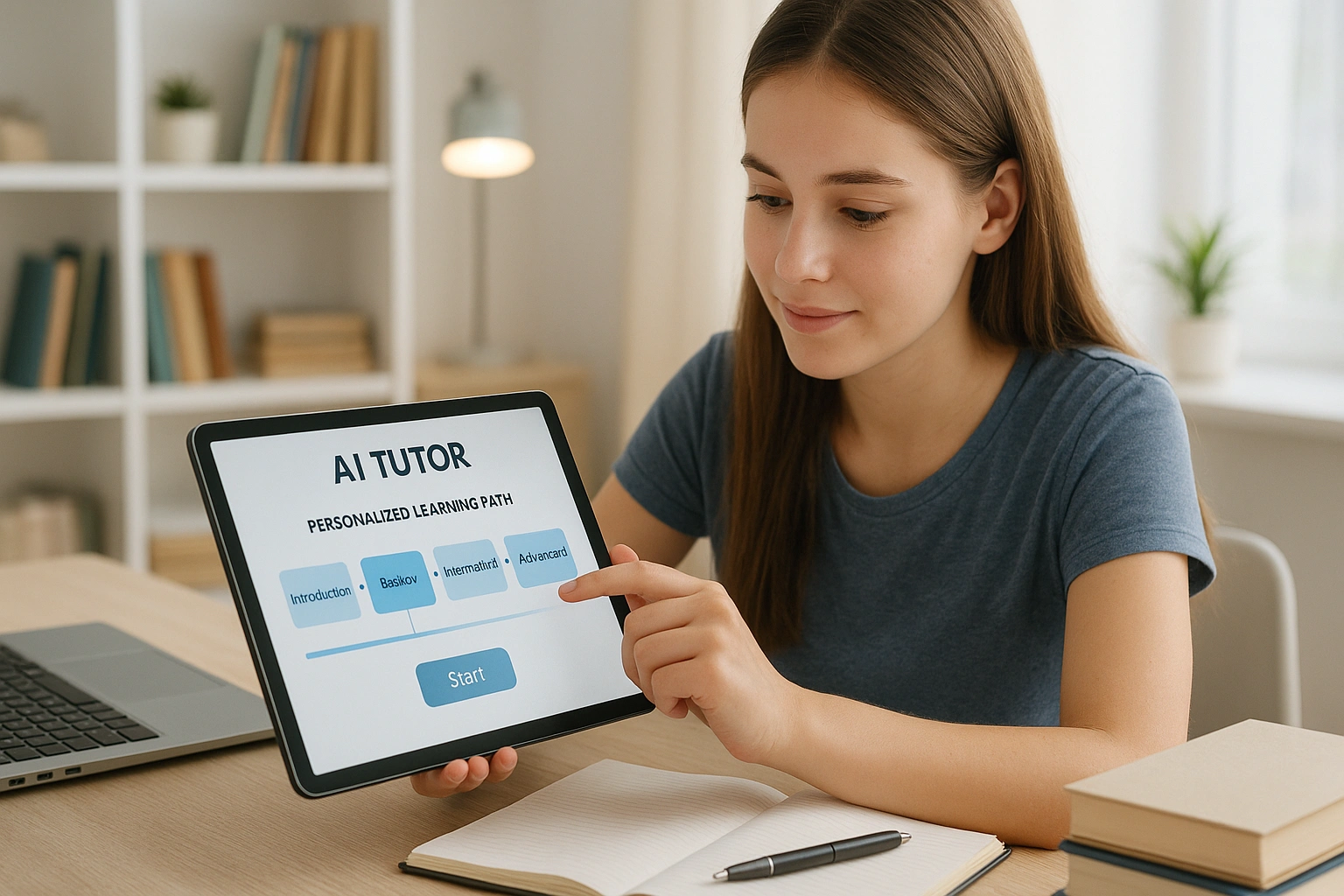
An AI tutor doesn’t follow a rigid curriculum, and AI tutors for students adapt to each learner’s pace. AI tutors for students assess skills in real-time, adjusting difficulty and content to match progress. With AI tutors for students, mastering a concept quickly means moving forward, while struggling students receive extra support. This approach with AI tutors for students ensures learning is always challenging yet never overwhelming.
Safe, Judgment-Free Practice
One of the biggest barriers to learning is the fear of looking foolish. Students often hesitate to ask questions in class. An AI tutor provides a completely private and non-judgmental space to make mistakes, ask “silly” questions, and practice until you achieve mastery.
- Practice speaking a new language without fear of mispronouncing.
- Work through a math problem as many times as needed.
- Ask for definitions of basic terms without embarrassment.
Accessibility and Affordability
Private human tutoring can be incredibly expensive and limited by scheduling. AI tutors democratize education by offering high-quality, one-on-one support at a fraction of the cost—or sometimes for free. They are available anytime, anywhere, on any device. For more on how AI is transforming access to services, check out our article on digital finance trends.
How It Works: The Brains Behind the Screen
AI tutors are powered by Large Language Models (LLMs) and a pedagogical framework designed to guide, not just inform. The process is a continuous, interactive loop.

Here’s a simplified flow of a typical interaction:
| Step | Action | Technology Used | Outcome |
|---|---|---|---|
| 1 | Student asks a question or starts a lesson. | User Input | “How does photosynthesis work?” |
| 2 | AI analyzes the query and the student’s learning history. | Natural Language Processing (NLP) & Machine Learning | The AI recognizes the topic and assesses the student’s prior knowledge. |
| 3 | AI provides a starting explanation and asks a guiding question. | Generative AI & Socratic Method | “Photosynthesis is how plants make food. What do you think plants need to grow?” |
| 4 | The student responds, and the AI adapts its next step. | Adaptive Learning Engine | The conversation continues, with the AI providing explanations, quizzes, and feedback based on the student’s input. |
Real-Life Use Case: A Review of Khanmigo
To understand the real-world impact of **AI tutors for students**, I spent a month using **Khanmigo**, the AI assistant from Khan Academy, to learn introductory computer programming. As someone with minimal coding experience, the prospect was daunting.
Khanmigo was a revelation. When I got stuck on a coding challenge, I could ask it for a hint. Instead of giving me the code, it would ask me questions like, “What is the goal of this line of code?” or “Have you remembered to close your loop?” This forced me to think through the logic myself. It also acted as a debate partner for brainstorming ideas and a writing coach for documenting my projects.
| Pros | Cons |
|---|---|
| ✅ Truly Socratic: Never gives direct answers, which promotes real learning. | ❌ Subscription-Based: Requires a monthly donation to Khan Academy for access. |
| ✅ Fully Integrated: Works seamlessly with Khan Academy’s vast library of content. | ❌ Can Be Slow: Sometimes the AI takes a moment to formulate its Socratic responses. |
| ✅ Versatile Roles: Can act as a tutor, debate partner, or writing coach. | ❌ Limited to On-Platform Content: Can’t help with homework from outside the Khan Academy ecosystem. |
Top AI Tutors for Students Compared
Khanmigo is a top contender, but the world of **AI learning assistant apps** is vast. Here’s how it compares to other leading platforms.
| Tool | Key Features | Pros | Cons | Best For |
|---|---|---|---|---|
| Khanmigo | Socratic dialogue, integrated with Khan Academy curriculum, multiple AI roles. | Promotes deep learning, safe and reputable, covers many subjects. | Subscription-based, can’t help with external homework. | Guided, curriculum-aligned learning. |
| Quizlet Q-Chat | Turns flashcards into adaptive conversations, personalized quizzes. | Excellent for test prep, makes memorization interactive. | Requires a Quizlet Plus subscription, less about teaching new concepts. | Studying for exams and concept reinforcement. |
| Duolingo Max | AI-powered conversation practice, explanations for why answers are right/wrong. | Makes language learning immersive and conversational. | Only for languages, premium subscription feature. | Serious language learners. |
| Socratic by Google | Photo-based problem solver, connects to web resources and videos. | Completely free, great for quick help on specific problems. | More of a ‘checker’ than a conversational ‘tutor’. | Getting unstuck on STEM homework. |
Common Mistakes to Avoid
To get the most out of an AI tutor, you need to use it correctly. Avoid these common pitfalls.
- Passive Learning: Don’t just read the AI’s responses. Engage with it. Ask follow-up questions, challenge its explanations, and connect the topic to what you already know.
- Trying to Outsmart It: Don’t try to trick the AI into giving you a direct answer. The Socratic method is a feature, not a bug. Embracing it is key to learning.
- Ignoring the Fundamentals: An AI tutor can’t build a house on a weak foundation. If you’re missing prerequisite knowledge, ask the tutor to help you review the basics first.
- Using It Only for Homework: Explore topics you’re curious about! Ask the AI to explain black holes, debate the themes of *1984*, or teach you the basics of a new language.
- Forgetting about Data Privacy: Always use reputable platforms from established educational organizations. Be mindful of what personal information you share, an issue often highlighted by tech journals like Wired.
Expert Tips for Maximizing Learning
Use your **AI learning assistant app** like a pro with these tips.
- Set a Goal for Each Session: Start by telling the AI what you want to accomplish, e.g., “I want to understand the three main causes of the French Revolution.”
- Ask ‘Why’ and ‘What If’: Go beyond surface-level questions. Ask why a formula works or what would happen if a variable changed.
- Request Analogies: If a concept is too abstract, ask the AI to explain it with an analogy. For example, “Explain electricity like it’s a system of water pipes.”
- Summarize Your Learning: At the end of a session, ask the AI to quiz you on what you’ve just covered, or try to summarize the main points back to it.
“AI tutors are the great equalizer. They provide every student with a personal guide to their own curiosity. The future of learning isn’t about memorizing facts; it’s about knowing how to ask the right questions.”
– Sal Khan, Founder of Khan Academy
Frequently Asked Questions (FAQ)
Q: What is the best AI tutor for students?
A: The ‘best’ AI tutor depends on your needs. Khanmigo is excellent for a guided, curriculum-aligned experience across many subjects. Duolingo is unmatched for language learning, while Socratic is great for quick, visual explanations in STEM fields.
Q: Can AI tutors replace human teachers?
A: No. AI tutors are powerful supplements but lack the empathy, mentorship, and nuanced understanding of a human teacher. They are best used as a tool to support classroom learning, not replace it.
Q: Are AI tutors effective for all age groups?
A: Yes, but the type of tool matters. Gamified apps like Duolingo are great for younger learners, while more sophisticated platforms like Khanmigo are better suited for high school and college students who can engage in complex dialogue.
Q: How much do AI tutors cost?
A: Costs vary. Some tools, like Socratic, are completely free. Others, like Khanmigo and the premium versions of Duolingo or Quizlet, operate on a monthly subscription model, often ranging from $10 to $30 per month.
Q: How do AI tutors handle different learning styles?
A: They adapt by offering multiple ways to learn a concept. An AI tutor might provide a text explanation, a visual diagram, an interactive quiz, and a link to a video tutorial, allowing students to engage with the material in the format that works best for them.
Conclusion
The era of one-size-fits-all education is over. AI tutors for students are transforming learning into a more personalized, engaging, and effective experience. With AI tutors for students providing instant feedback, adapting to individual needs, and fostering a safe space for curiosity, learners gain control over their own education. While AI tutors for students won’t replace teachers, they are a powerful ally in academic growth. By using AI tutors for students thoughtfully, you can deepen understanding in any subject and unlock your full potential from home.