Introduction
For most small business owners, the dream is growth, but the reality is a daily battle against a never-ending to-do list. How do you find time to focus on strategy when you’re busy answering the same customer emails over and over? This isn’t just a hypothetical question; it’s the real story of countless entrepreneurs navigating the path to AI small business success. But what if there was a way to automate the noise and unlock your business’s true potential? This AI small business success story takes you inside the journey of a small e-commerce brand that was struggling to scale. You’ll see the specific, affordable AI tools they used to transform their operations and achieve measurable results, demonstrating how AI small business success is possible even for solo entrepreneurs. By following this approach, any entrepreneur can move closer to their own AI small business success while saving time and growing revenue.
The Subject of Our Case Study: “Artisan & Oak”
Our case study focuses on “Artisan & Oak,” a fictional but highly realistic online store run by a solo entrepreneur named Clara. Artisan & Oak sells high-quality, handmade wooden furniture. Clara is passionate about her craft, but her business had hit a plateau, highlighting a challenge common to many seeking AI small business success. Her days were consumed by manual, repetitive tasks, leaving her with little time to design new products or focus on marketing strategy, a barrier that AI small business success tools are designed to overcome. By adopting smart automation, Clara found a pathway to AI small business success, transforming inefficiencies into streamlined workflows. This story is a classic example of AI small business success in action, showing how accessible tools can empower small entrepreneurs to achieve real growth.
The global market for automation technologies is booming, with a strong emphasis on accessible tools for small and medium-sized businesses. As reported by sources like Forbes, the adoption of AI is a key differentiator for growing companies. Clara’s story is a perfect illustration of this trend in action.
The Challenge: Pinpointing the Bottlenecks
Before implementing any solution, Clara first had to identify the key areas where her time was being wasted, a crucial step for achieving AI small business success. These bottlenecks were common obstacles that many entrepreneurs face on the path to AI small business success. By clearly mapping out the inefficiencies, Clara created a roadmap toward AI small business success, ensuring that her automation efforts would target the tasks that mattered most. Recognizing and addressing these key challenges was essential for laying the foundation of AI small business success in her operations.
Overwhelming Customer Inquiries
Clara was spending 2-3 hours every day answering the same handful of questions from customers, a common challenge that many entrepreneurs face on the journey to AI small business success. This repetitive task highlighted a key area where AI small business success could be achieved through automation. By addressing these routine inquiries, Clara could focus on activities that truly drive AI small business success. Reducing time spent on manual responses became a crucial step toward long-term AI small business success for her growing company.
Inefficient and Inconsistent Marketing
Clara knew she needed to engage her customers with email marketing, but she rarely had the time. When she did send an email, it was a generic blast to her entire list, resulting in low open rates and few sales. She had no system for nurturing new leads or re-engaging past customers.
Lack of Actionable Customer Data
Clara’s customer information was spread across her e-commerce platform, her email, and various spreadsheets. She had no centralized view of her customers and no easy way to identify her most loyal patrons or those at risk of churning. Understanding the financial impact of these inefficiencies was the first step toward finding a solution.
The Solution: Implementing a Trio of Affordable AI Tools
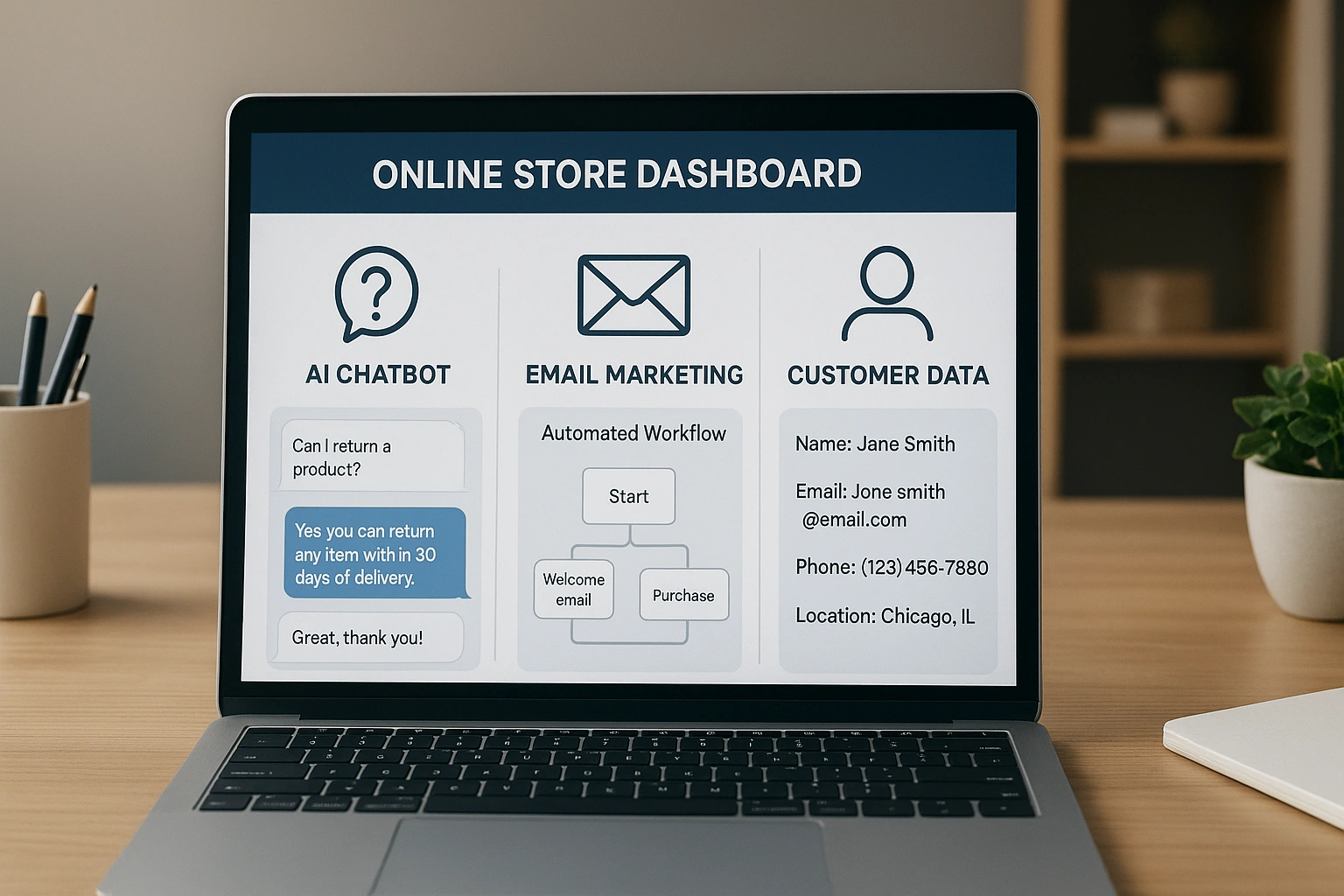
Clara’s goal was to build an automated system that could handle these repetitive tasks for her. She chose a stack of three affordable, user-friendly AI tools that could work together.

Here’s a breakdown of the chosen tools and their roles:
| Tool | Primary Function | How AI Helped |
|---|---|---|
| Tidio | Customer Service Automation | An AI chatbot was trained on the store’s FAQs to provide instant, 24/7 answers to common customer questions. |
| HubSpot | Marketing and CRM | The free CRM centralized all customer data. The Marketing Hub’s AI helped write personalized emails and automate campaigns. |
| Zapier | Integration and Workflow Automation | Acted as the “glue” between the other apps. For example, a new lead from the Tidio chatbot was automatically added to a HubSpot workflow. |
The Implementation and Results
This is the heart of our **AI business case study**: the measurable impact of these tools. Clara implemented the new system over a single weekend.
The Tidio chatbot was an immediate success, handling over 70% of all incoming support queries within the first week. In HubSpot, Clara created a simple three-part welcome email series for new subscribers and a cart abandonment workflow that offered a small discount to customers who had left items in their cart. Zapier ensured that all the systems talked to each other seamlessly.
| Metric | Result |
|---|---|
| Time Saved | An average of 15 hours per week saved on administrative tasks. |
| Revenue Growth | A 30% increase in monthly revenue, largely driven by the cart abandonment workflow. |
| Email Open Rate | Increased from 18% to 45% for the automated welcome series. |
| Customer Satisfaction | Positive feedback increased, with customers praising the instant support from the chatbot. |
Key Takeaways for Your Business
Clara’s story provides a clear blueprint for **AI small business success**. Here’s a comparison of how her key business functions were transformed.
| Business Area | Before AI (The Manual Way) | After AI (The Automated Way) |
|---|---|---|
| Customer Service | Slow, manual email responses during business hours only. | Instant, 24/7 answers from an AI chatbot, with seamless handover to a human for complex issues. |
| Marketing | Occasional, generic email blasts to the entire list. | Automated, personalized email workflows for new leads and abandoned carts. |
| Data Management | Customer data scattered across multiple, disconnected systems. | A single, unified view of every customer in a free CRM. |
Common Mistakes Artisan & Oak Avoided
Part of Clara’s success was avoiding the common pitfalls of automation. Here are the key mistakes she sidestepped.
- Automating a Bad Process: Before she implemented the chatbot, Clara first documented her most common customer questions. She didn’t just automate chaos; she automated a clear, defined process.
- Forgetting the Human Touch: The chatbot was programmed to be friendly and helpful, and it had a clear and easy option to “talk to a human” at any time.
- Not Investing Time to Learn: Clara dedicated a weekend to watching tutorials and learning the basics of each tool, which made the implementation smooth.
- Ignoring Data Security: She chose reputable, well-known platforms with strong security and privacy policies. As experts cited by Google often advise, data security is paramount when choosing any cloud tool.
Expert Tips & Best Practices from the Case Study
You can replicate this success in your own business by following these best practices.
- Start with Your Biggest Time-Waster: Don’t try to automate everything at once. Identify the single most repetitive, time-consuming task in your day and find an AI tool to solve it first.
- Use Free Tiers and Trials: All the tools in this case study offer free or trial versions. Test them out to see if they fit your workflow before you commit to a paid plan.
- Connect Your Tools: The real power comes when your tools talk to each other. Use an integrator like Zapier to create a seamless flow of information between your apps.
- Measure Everything: Track the time you save and the revenue you generate from your automations. This will prove the ROI and justify the investment.
“AI automation gave me back 15 hours a week. That’s time I now spend designing new products and talking to my best customers,” says Clara, the fictional founder of Artisan & Oak. “It didn’t just make my business more efficient; it made me fall in love with my work again.”
Frequently Asked Questions (FAQ)
Q: What was the total monthly cost for the AI tools in this case study?
A: The total monthly cost for the tools used by ‘Artisan & Oak’ was approximately $80. This included a starter plan for HubSpot Marketing Hub, a basic plan for Tidio, and a starter plan for Zapier. This demonstrates that a powerful AI automation stack can be very affordable.
Q: How long did it take to see a return on investment (ROI)?
A: The business saw an immediate return on investment in terms of time saved—over 10 hours in the first week. A measurable financial ROI, with the revenue from chatbot-recovered sales exceeding the monthly software cost, was achieved within the first month.
Q: Can a non-technical person really set these tools up?
A: Yes. The tools featured in this case study—HubSpot, Tidio, and Zapier—are all designed with user-friendly, no-code interfaces. They offer extensive tutorials and customer support, making them accessible to business owners without a technical background.
Q: Did customer satisfaction go down after implementing an AI chatbot?
A: No, customer satisfaction actually improved. The chatbot provided instant answers to common questions 24/7, which customers appreciated. For complex issues, the bot seamlessly handed the conversation over to a human, ensuring that customers received the best of both worlds: speed and expertise.
Q: What is the best first step for a small business wanting to replicate this AI success?
A: The best first step is to identify your single biggest administrative bottleneck. Is it answering repetitive emails? Is it manually posting on social media? Start by finding a free or low-cost AI tool that solves that one specific problem. Small, focused wins are the key to building a successful automation strategy.
Conclusion
The story of Artisan & Oak is a powerful testament to the transformative potential of AI for small businesses. This **AI business case study** shows that automation is no longer a luxury reserved for large corporations. With affordable, user-friendly tools, any entrepreneur can streamline their operations, improve their marketing, and unlock new avenues for growth. The key to **AI small business success** is not about replacing the human element, but about automating the mundane so you can focus on the work that truly matters.