
Introduction
The discussion around AI in education is often filled with futuristic hypotheticals and concerns about cheating. Yet while debates continue, a quiet revolution in AI in education is already taking place in classrooms worldwide. Teachers are moving beyond theory and actively applying AI in education to tackle long-standing challenges in teaching and learning. These real-world AI in education case studies from 2025 show how educators are using AI to save time, engage students, and create personalized learning experiences like never before.
What Are AI in Education Case Studies?
AI in education case studies are real-world examples showing how AI in education tools are successfully applied in classrooms. These studies move beyond the abstract potential of AI in education and highlight specific challenges teachers are solving and the measurable results they achieve. From a third-grade teacher using AI in education to create differentiated reading assignments to a university professor analyzing student discussions with AI in education, these examples show how AI is transforming learning across grade levels.
These case studies are critical for understanding the true impact of AI. The global market for AI in education is projected to grow exponentially, reaching nearly $20 billion by 2027. This isn’t just about technology adoption; it’s about a fundamental shift in teaching and learning methodologies, and these real-world examples are the proof.
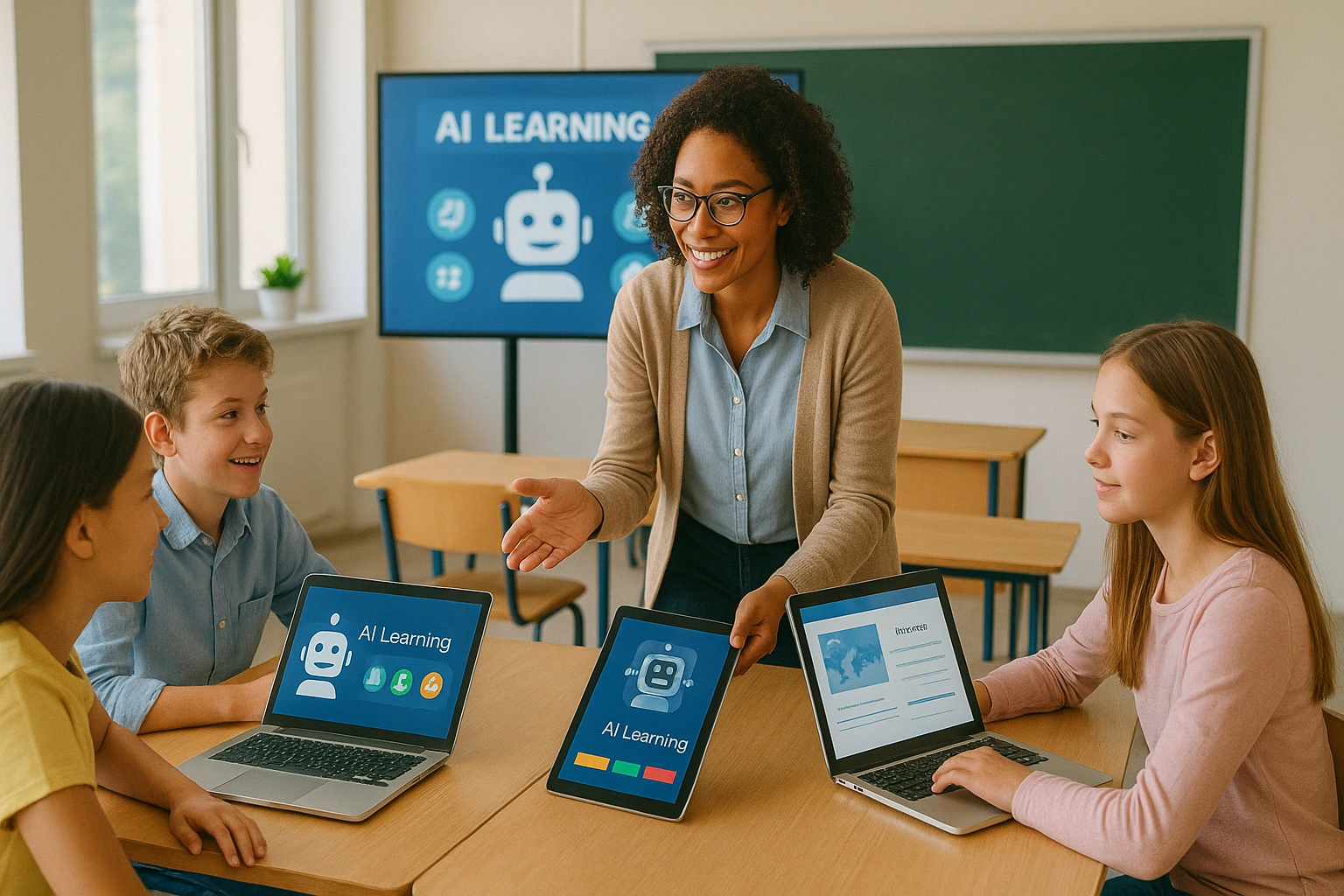
Why These Case Studies are a Beacon for the Future
Studying these AI in education examples provides a clear vision of how AI in education can create more effective and equitable classrooms. By examining AI in education in practice, educators can see how AI in education tools improve learning outcomes and support every student. These insights from AI in education case studies help shape strategies for a future where technology enhances teaching and learning for all.
Case Study Theme 1: Hyper-Personalized Learning at Scale
The traditional one-size-fits-all classroom model struggles to meet the needs of every student. AI is finally solving this. AI tutors and adaptive learning platforms can assess each student’s knowledge gaps and create a unique learning path, allowing every student to learn at their own pace.
Case Study Theme 2: Freeing Teachers from Administrative Burden
Teacher burnout is a global crisis, largely fueled by overwhelming administrative workloads. AI is a powerful tool for automation, taking over the most time-consuming tasks.
- AI can grade multiple-choice and even short-answer questions instantly.
- AI can generate lesson plans, worksheets, and presentations tailored to a specific curriculum standard in minutes.
- AI can handle routine parent communications and progress reports.
Case Study Theme 3: Boosting Engagement and Critical Thinking
AI can transform passive lectures into dynamic, interactive experiences. It can act as a debate partner for a student, a creative brainstorming tool for a group project, or a guide for complex simulations, fostering a deeper level of engagement and critical thought. For more on how AI is shaping our world, see this article on digital finance trends.
The Framework of a Successful AI Implementation
Every successful **AI in education case study** follows a simple but powerful framework: a teacher identifies a specific problem and strategically applies the right AI tool to solve it.

Here’s a breakdown of the typical journey:
| Stage | Description | Example |
|---|---|---|
| 1. Identify the Pain Point | The teacher identifies a specific, recurring challenge in their classroom. | “It takes me 3 hours to create differentiated reading passages for my students.” |
| 2. Select the Right Tool | The teacher researches and chooses a user-friendly AI tool designed for that specific task. | The teacher uses an AI tool like MagicSchool.ai. |
| 3. Implement and Measure | The teacher uses the tool and measures the outcome. | “I can now create reading passages for three different levels in 15 minutes. My students are more engaged because the text is at their level.” |
Case Study in Action: A High School English Class
Let’s look at a detailed **AI classroom success example**. “Mr. Carter,” a 10th-grade English teacher, was struggling with a common problem: providing timely, meaningful feedback on student essays. With 120 students, he was spending his entire weekend grading, and his feedback was often rushed.
Mr. Carter implemented **QuillBot**, an AI writing assistant, into his workflow. He taught his students how to use the “Grammar Checker” to clean up their first drafts and the “Paraphraser” to improve sentence variety. For his part, he used the AI to help him leave more effective comments. Instead of just correcting an error, he would ask the AI to “explain the rule for subject-verb agreement” and paste that explanation into his comments. This turned his feedback from simple correction into a teachable moment.
| Pros | Cons |
|---|---|
| ✅ Improved Writing Quality: The quality of the final drafts submitted by students improved significantly. | ❌ Risk of Over-Reliance: Students needed to be taught to use the tool thoughtfully, not just accept every suggestion. |
| ✅ Saved Teacher Time: Mr. Carter’s grading time was cut by nearly 40%. | ❌ Doesn’t Teach Higher-Order Skills: The AI is great for grammar and syntax, but it can’t teach argumentation or analysis. |
| ✅ Empowered Students: Students felt more confident in their writing and had more agency in the editing process. | ❌ Requires Digital Access: This approach requires all students to have access to a computer. |
Comparing AI Tools from Real-World Case Studies
Different tools are being used to solve different problems. Here’s a look at some of the most popular tools and the success stories they’re creating.
| Tool | Primary Use Case | Success Story Example |
|---|---|---|
| Khanmigo | Personalized Tutoring | A math teacher uses it to provide one-on-one support to 30 students simultaneously. |
| Curipod | Lesson Planning & Engagement | A social studies teacher turns a dry lecture into an interactive poll and discussion. |
| MagicSchool.ai | Teacher Productivity | A science teacher generates a lab report rubric and parent emails in under five minutes. |
| Duolingo for Schools | Language Practice | A Spanish teacher uses it to assign gamified vocabulary practice for homework. |
Common Mistakes to Avoid on Your AI Journey
To create your own success story, it’s important to be mindful of the potential pitfalls. Avoid these common mistakes.
- Adopting AI Without a Clear “Why”: Don’t use a tool just because it’s trendy. Start with a real problem you want to solve.
- Failing to Teach Ethical Use: Have an explicit conversation with students about what constitutes appropriate use versus academic dishonesty.
- Not Vetting Tools for Privacy: Be sure any tool you use has a clear and strong student data privacy policy. As experts cited by Google often emphasize, protecting student data is a critical responsibility.
- Assuming a One-Size-Fits-All Approach: What works for a high school English class may not work for a kindergarten class. Choose tools that are appropriate for your students’ age and developmental level.
Expert Tips for Success
Ready to pioneer your own **AI classroom success examples**? Here are some best practices from teachers on the front lines.
- Start with a Low-Stakes Task: Your first experiment with AI shouldn’t be for a major grade. Try it out on a fun warm-up activity or a lesson plan for yourself.
- Use AI to Enhance, Not Replace: Use AI to create the first draft of a lesson plan, then use your professional expertise to refine and perfect it.
- Let Students Be Co-Designers: Involve your students in the process. Ask them for feedback on the tools and brainstorm creative ways to use them.
- Share Your Successes (and Failures): Talk to other teachers in your school. The best way to advance is by building a community of practice.
“AI gave me back my Sundays. The time I used to spend on grading and lesson prep, I now spend on designing the creative, high-impact learning experiences that made me want to be a teacher in the first place.”
– A high school teacher and AI early adopter
Frequently Asked Questions (FAQ)
Q: Will AI replace teachers?
A: No. The consensus from all major AI in education case studies is that AI is a tool to augment and support teachers, not replace them. AI handles administrative tasks and personalized practice, freeing up educators to focus on mentorship, critical thinking, and the human elements of teaching.
Q: What is the main benefit of using AI in the classroom?
A: The single biggest benefit is the ability to provide personalized learning at scale. AI tools can adapt to each student’s individual pace and learning style, providing extra support to those who are struggling and advanced challenges to those who are ahead, all within the same classroom.
Q: How can teachers prevent cheating with AI?
A: Educators are shifting their focus from the final product to the learning process. This involves designing assignments that require personal reflection and critical analysis, teaching students to use AI ethically as a research assistant, and using AI tools that show the history of a student’s work.
Q: Are AI education tools expensive for schools?
A: While some enterprise-level tools can be expensive, many of the most effective AI tools for the classroom, like Khanmigo and Curipod, offer affordable or even free plans specifically for educators, making them highly accessible.
Q: What are some AI classroom success examples?
A: Success examples include a math teacher using an AI tutor to help students at different skill levels simultaneously, an English teacher using an AI writing assistant to provide more detailed feedback on essays, and a history teacher using an AI tool to generate an interactive, engaging lesson plan in minutes.
Conclusion
The AI in education case studies from classrooms in 2025 show a clear and optimistic picture of how technology can enhance learning. Thoughtfully applied, AI in education is not a threat but a powerful tool for teacher empowerment. These AI in education success stories highlight how educators can use AI to create more personalized, engaging, and equitable learning experiences for every student. The future of teaching is shaped not by robots, but by human teachers leveraging AI in education to maximize impact and support student success.